Barbados Seeks Scientific, Commercial Use from Sargassum Microbes
Barbados is working to transform a discovery involving three previously unidentified microbial strains found in decomposing sargassum into new scientific, environmental and commercial opportunities.
The discovery, made by University of the West Indies researcher Dr. Bidyut Mohapatra, has attracted the attention of government officials and pharmaceutical companies. Science and Technology Minister Jonathan Reid said the findings could help Barbados strengthen its biotechnology and advanced-manufacturing sectors while creating a platform for locally owned industries.
The microorganisms were isolated from decomposing sargassum collected at Long Beach, Barbados. One of the organisms, Chryseobacterium barbadensis, was identified after Mohapatra developed specialised techniques to isolate and cultivate it.
The bacterium can break down cellulose and alginate, two major components of sargassum biomass. Those properties could support research into the conversion of the seaweed into biofuels, chemicals and other products. The University of the West Indies said the organism has been independently validated by the Belgian Coordinated Collections of Microorganisms and Germany’s DSMZ culture collection, with the discovery subsequently authenticated through the US National Center for Biotechnology Information.
Two other microorganisms identified in the research are Arthrobacter bajanensis and Streptomyces sargassi. The first two names honour Barbados, while the third reflects the sargassum environment from which it was recovered.
According to reporting by Barbados TODAY, Arthrobacter bajanensis may have applications in the remediation of marine oil spills. Chryseobacterium barbadensis is being studied for enzyme production, biofuel development, methane-related environmental applications and nitrogen fixation. Streptomyces sargassi is of particular interest because members of the Streptomyces group are important sources of pharmaceutical compounds, including antibiotics.
The Barbados Government is taking steps to secure intellectual-property protection for the discoveries. Reid said the process is being facilitated through the Attorney General’s Office, with the aim of ensuring that the organisms and any technologies developed from them remain connected to Barbados.
The decision follows interest from pharmaceutical companies seeking to acquire the microorganisms. Mohapatra said several companies approached him after he presented the research at an American Society for Microbiology conference in Washington, DC.
Rather than sell the organisms outright, the researcher has argued that Barbados should retain ownership of the intellectual property and negotiate future partnerships from a stronger position. That approach could allow the country to benefit from licensing, research collaborations, manufacturing and the development of locally based companies.
Patent applications, particularly in major international markets, can take several years to complete. In the meantime, government officials and researchers are expected to continue evaluating the organisms, documenting their properties and determining which commercial applications are technically and legally viable.
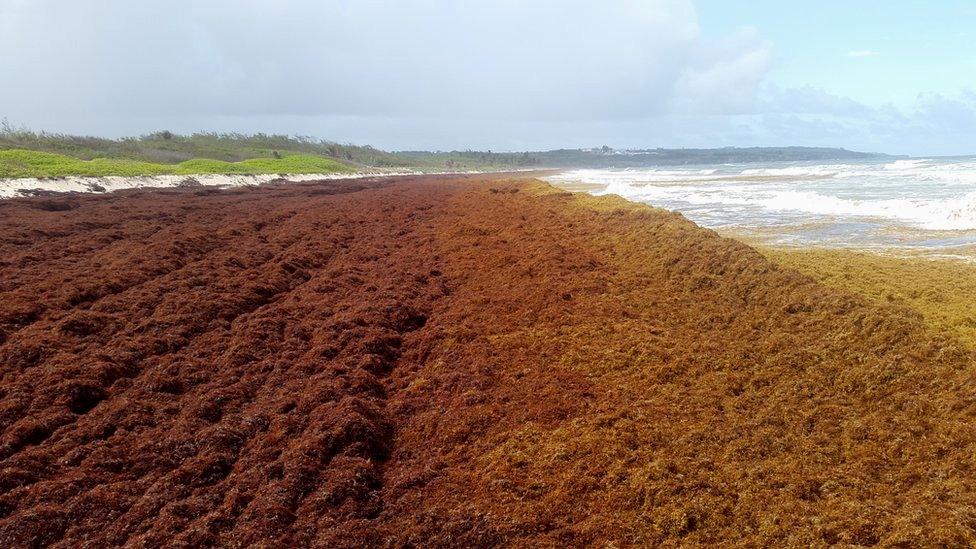
Sargassum has become a recurring challenge for Caribbean countries. Large quantities of the seaweed wash ashore, affecting beaches, tourism, marine ecosystems and coastal communities. Its decomposition can also create unpleasant odours and complicate collection and disposal.
The microbial discovery offers a different way of viewing the problem. Instead of treating sargassum only as waste, Barbados is exploring whether its biological properties can be used as a source of raw materials, enzymes, pharmaceuticals, biofuels and environmental technologies.
The University of the West Indies has described Chryseobacterium barbadensis as a potentially useful organism for accelerating the breakdown of sargassum. If researchers can develop safe, efficient and scalable processes, the organism could become part of a wider strategy for managing seaweed while producing commercially valuable outputs.
However, the discovery does not mean that commercial products are immediately available. Further research will be required to confirm the organisms’ performance at industrial scale, establish safety and regulatory requirements, determine production costs and identify reliable markets.
Reid said the Government’s ambitions extend beyond obtaining patents. Barbados is also seeking to create the laboratories, research facilities and advanced-manufacturing capabilities needed to turn scientific discoveries into products.
The minister pointed to plans involving scientific facilities at Newton and a proposed scientific park at Greenland. He said the country wants to attract and retain researchers while encouraging young Barbadians to pursue careers in fields such as microbiology, ocean science, geology, atmospheric research, artificial intelligence and engineering.
The Government is also working with international partners, including the United Nations Industrial Development Organization, as it pursues a broader advanced-manufacturing agenda. Officials expect future projects to incorporate laboratory technologies, automation and robotics into domestic production.
For Barbados, the goal is to move beyond conducting research and exporting raw materials. The country wants to build a pipeline that begins with marine research, continues through intellectual-property protection and product development, and ends with manufacturing and exports.
Although Barbados has a relatively small land area, its maritime jurisdiction provides access to a much larger economic space. Reid said the country’s Exclusive Economic Zone contains marine organisms, minerals and other resources that could support new industries if they are studied responsibly and developed within an appropriate legal and environmental framework.
The sargassum microbes could therefore become an early example of a broader “blue economy” strategy. Such a strategy would use marine resources to support economic growth while protecting ecosystems and ensuring that local communities share in the benefits.
That ambition will depend on more than scientific discovery. Barbados will need effective intellectual-property management, research funding, regulatory oversight, private-sector investment, skilled personnel and partnerships with international institutions. It will also need to ensure that commercial development does not create new environmental risks.
The Government’s effort to retain the intellectual property reflects a wider concern among small states: scientific discoveries made locally can generate substantial value elsewhere if the technology, patents and production capacity are transferred overseas.
By protecting the discoveries and supporting further research, Barbados hopes to give local companies an opportunity to develop products and services around the microorganisms. The proposed Barbados Living Lab is expected to play a role in that process by providing space where researchers, students and businesses can continue testing applications and developing technologies.
Reid said the work could help change the relationship between scientific research and industry in Barbados. The country’s marine environment, he suggested, should not be viewed only as a source of tourism or natural beauty but also as a foundation for knowledge-intensive industries.
The discovery of the three microbial strains is still at an early stage of commercial development. Yet it has already helped place Barbados at the centre of an emerging conversation about biotechnology, sargassum management and marine innovation.
If the research can be translated into safe, marketable products, the organisms could help the island address a persistent environmental problem while building new capabilities in pharmaceuticals, biofuels, environmental remediation and advanced manufacturing. For Barbados, the larger opportunity may be the creation of an innovation system capable of turning future scientific discoveries into locally owned industries.