Kagan and Soai Win Nobel Prize in Chemistry
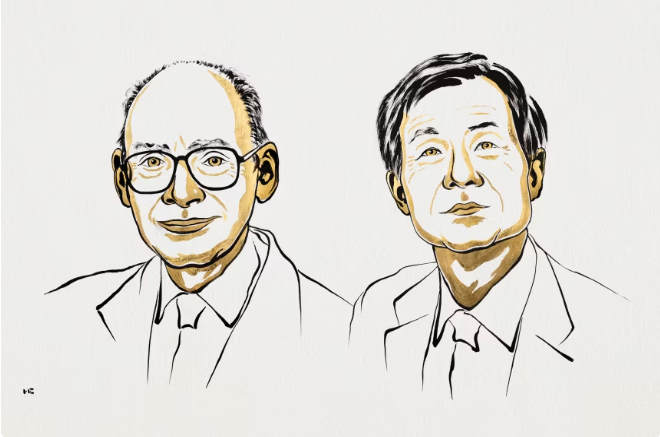
French chemist Henri B. Kagan and Japanese chemist Kenso Soai have been awarded the 2026 Nobel Prize in Chemistry for discoveries that help explain how nature came to favour one “mirror image” form of a molecule over the other. The Royal Swedish Academy of Sciences announced the prize Wednesday in Stockholm.
The academy recognized the pair “for the discovery of non-linear effects and autocatalysis in asymmetric organic synthesis.” The prize is worth 12 million Swedish kronor, about US$1.2 million, shared between the two laureates.
Some molecules, such as amino acids, exist in two forms that mirror each other, yet living organisms contain only one of them. The property is known as chirality, from the Greek word for “hand,” because left and right hands are mirror images that cannot be perfectly overlaid.
Heiner Linke, chair of the Nobel Committee for Chemistry, said the two had solved a mystery more than a century old: how this one-handedness, called homochirality, can emerge spontaneously.
Kagan, working in France in the early 1980s, found ways to control chemical reactions with different catalysts, allowing scientists to produce more of one mirror-image molecule. Soai then built on that work, designing a reaction in which only one of the two forms emerged. That reaction is now known as the Soai reaction. The committee noted that, other than life itself, no one had previously achieved that result.
Committee member Peter Somfai called it “probably the coolest experiment in organic chemistry.”
The work also has practical weight. Phillip Broadwith of Chemistry World said it lets scientists choose which mirror image to make, which is crucial for manufacturing drugs, flavors and fragrances. The Nobel committee said the discoveries have been decisive for chemists designing reactions for pharmaceutical manufacturing.
Kagan is affiliated with Université Paris-Sud, and Soai is a professor emeritus at Tokyo University of Science. Soai told reporters he was out shopping near his home in Hiroshima when the committee called, and said he was especially glad to share the prize with Kagan. The committee said it had not immediately been able to reach Kagan.