Counterfeiters busy in Trinidad, official says fake bills rampant
(Trinidad Guardian) One day after a San Juan market vendor reported that he was paid with a counterfeit $100 bill at the Central Market in Port-of-Spain, a source in the Bankers’ Association of Trinidad and Tobago (BATT) is saying counterfeits are much more rampant than the public knows.
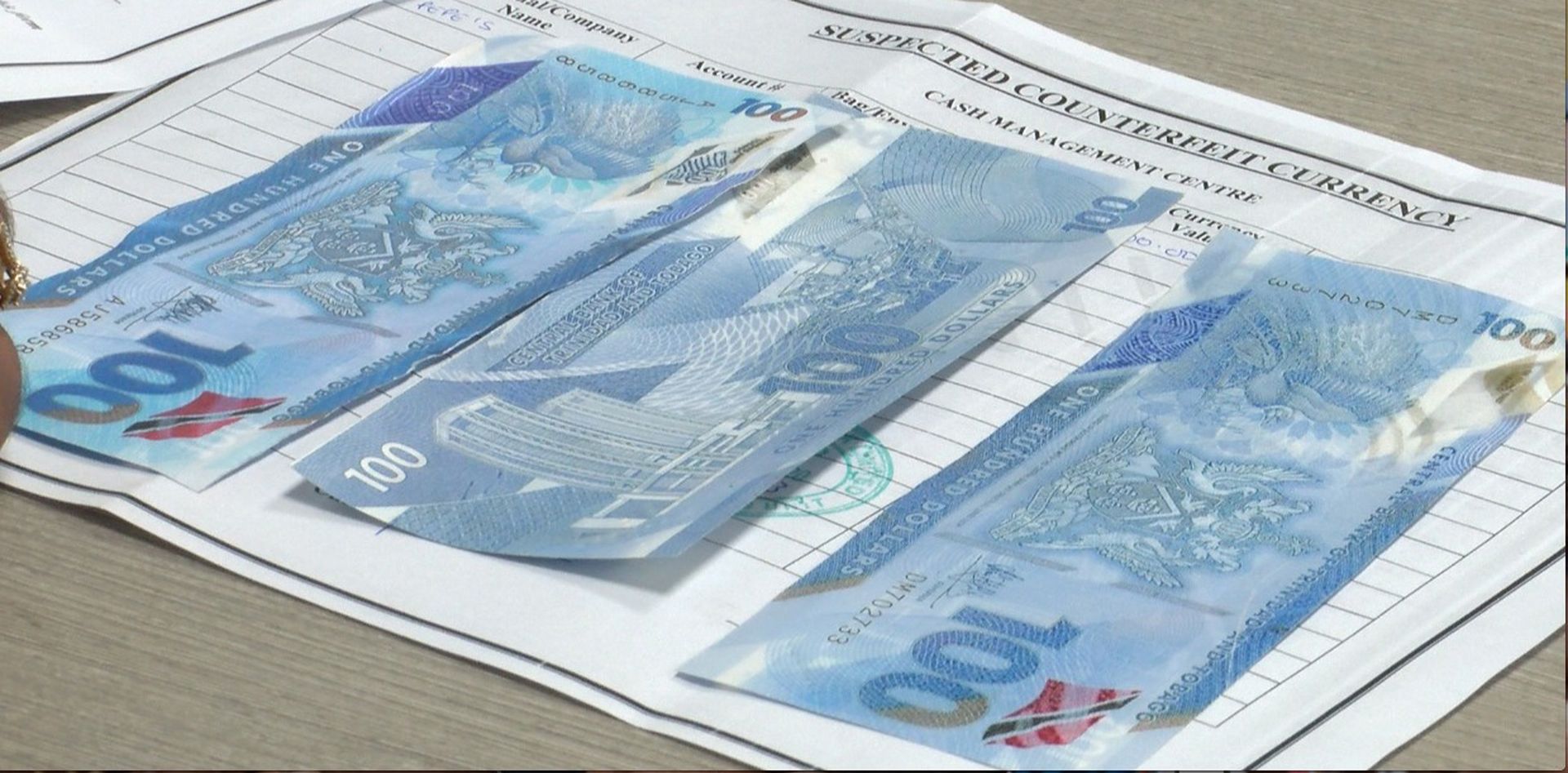
The source presented four counterfeit $100 bills during an interview yesterday and said every day, banks across the country have been seizing fake $100 notes from customers.
When the BATT source was asked how many counterfeit bills the association had collected since the new polymer $100 note was introduced last December, he said, “I can’t say, I wouldn’t be able to give you a figure, I just pulled out what we got for this week or today. This seems like a novelty to you but we are seeing it every day.”
He said a recent ‘change of policy’ at the T&T Police Service’s Fraud Squad meant the association was also not reporting counterfeits to the unit.
“Before, it used to be that the requirement was for the bills themselves to be sent to the Fraud Squad, the Fraud Squad would do the testing of the bills and confirm what is counterfeit and what isn’t. But it seemed like for many years the Fraud Squad had a lot of those bills piling up and a lot of them had to go to the Forensic Sciences Centre and I don’t know what they did but eventually, they stopped it.”
Now, he said, the association is left to figure out what to do with the bills they collect from citizens who have been scammed with the fake bills.
“Whether we send them now to the Central Bank or what that still has to be resolved.”
However, a senior police officer whose mandate is to investigate white-collar crime told Guardian Media yesterday that the law is clear on anyone caught with counterfeit bills.
“Anyone caught in possession of a counterfeit bill or utters a forged bill can be arrested by any police officer and charged.”
He said if counterfeit bills are taken to the bank, there are two things that could likely happen.
“The bank can later contact the individual if they have detected counterfeit bills in their account. However, if it is a large amount the bank can contact the police directly who can then initiate an investigation and reach out to the person whose bank account contained the counterfeit bills,” he said, adding as far as he is aware there has been no change in any policy by the Fraud Squad with regard to how banks are supposed to deal with counterfeiting cases.
Two of the bills presented to Guardian Media yesterday were similar to the one given to the market vendor – printed on a high gloss material, with replicas of a transparent window in the top left corner of the bill and an X in Braille at the bottom right. These two features are included in the real polymer note to ensure counterfeiters could not duplicate it. The hue on the fake bills was also darker than the original and the perforation on the letter X in Braille is also not as pronounced as the original.
The other two bills were printed on paper but also included replicas of a transparent window in the top left corner and an X in Braille on the bottom right. None of the four counterfeit bills glowed under an ultraviolet (UV) light when put to the test – a major indication they were fakes.
The BATT source said if someone does not have a UV light or is still unsure whether bills they receive are real, they can also tell by looking at the bill.
“The clarity of the bill is different, if you look at the crispness as well as the colour clarity, they differ markedly from the genuine bill – that is the first thing that stands out to me.”
Guardian Media reached out again to National Security Minister Stuart Young. Young, who on Monday said the public needs to familiarise themselves with the bill in order to spot counterfeit bills, was told of the information from the BATT source and asked, “Based on this, is the ministry taking any specific steps to inform or warn the public of these counterfeit notes in circulation?”
The following question was also sent to his WhatsApp, “The association says there was a policy change at the TTPS Fraud Squad which means the association no longer goes to the unit to report and hand over counterfeit bills. Can you speak to that policy and whether you, as minister, were informed of that change?”
Although all the messages were “Read” by 7 pm, Young did not respond up to press time.
In response to questions sent to the Central Bank yesterday by Guardian Media, Nicole Crooks, of the Bank’s External Relations department, said the bank will be re-launching its “Know Your New $100 Polymer Banknote” campaign and booking ads in print media to sensitise the public on the features of the bill.
Crooks said, “Following the introduction of the $100 polymer note in December 2019, the Central Bank is aware of periodic postings on social media and in the traditional media regarding attempts at forging the $100 polymer banknote.”
Crooks said the Central Bank will also be looking at other ways to reach the wider public audience, including vendors.